Saturday, February 14, 2015

The information is back with another juicy Android rumor today, this time on the subject of Google's Android One initiative, the company's effort to launch low-end handsets in developing countries that offer software updates directly from Google instead of carriers or device OEMs.

According to Amir Efrati, Google is exploring an expansion of Android One's benefits for users in these regions, where mobile data coverage is not only unreliable, but also disproportionately expensive compared to the rest of the world. Google wants to help alleviate some of the mobile data burden on users by "zero rating" data transmission for certain applications. That is, Google is attempting to form relationships with carriers and developers whereby certain apps would not use any of the allotted data on your mobile data plan.

The consumer draw is easy to see here. While Android One's offer of a "pure" and up-to-date Android experience may be moderately alluring to enthusiasts, less tech-savvy consumers aren't necessarily going to be all that interested. But if, for example, your WhatsApp/WeChat/LINE texting wouldn't use any of your mobile data, that could be very interesting to lots of people.

Zero rating isn't a new practice, and Google itself apparently tried to launch a zero-rating program for its own apps a few years back in some parts of the world, before eventually abandoning the effort.

Google is starting work on this initiative with companies like Flipkart and Snapdeal in India, along with developers of apps like Ola Cabs and Redbus. The idea is that Google will be a zero-rating middleman: developers work with Google to get their apps zero-rated, and Google works with the carriers to zero-rate all the developers it represents. The program isn't attempting to make all of your mobile data usage free, though, and is focusing on apps that consume a finite amount of data to begin with, at least for now. So, don't expect your VoIP calls or YouTube binges to be getting billed to the big G any time soon.

Google allegedly wants to expand this program outside of the initial Android One countries - if it makes it that far in the first place - but there isn't any talk about the US or Europe in The Information's article, so this seems aimed squarely at the developing world for the time being.

But perhaps we can hope, especially with news that Google may be considering launching its own MVNO here in America. Free YouTube streaming, anyone?

Rumor: Google's Next Android One Initiative Wants To Make Data Usage For Some Apps Completely Free

Friday, February 13, 2015

By Mark Buchanan, Nature
Financial traders are in a race to make transactions ever faster. In today's high-tech exchanges, firms can execute more than 100,000 trades in a second for a single customer. This summer, London and New York's financial centres will become able to communicate 2.6 milliseconds (about 10%) faster after the opening of a transatlantic fibre-optic line dubbed the Hibernia Express, costing US$300 million. As technology advances, trading speed is increasingly limited only by fundamental physics, and the ultimate barrier — the speed of light.


Through glass optical fibres, information travels at two-thirds of the speed of light in a vacuum (300,000 kilometres per second). To go faster, data must travel through the air. The corridors between Chicago and New York and New Jersey, and between London and Frankfurt, are bristling with efficient microwave and millimetre-wave links. An even more efficient network of lasers — based on military technology for in-flight signalling between aeroplanes — has been installed to link the New York and New Jersey as well as the London and Frankfurt financial exchanges.
Next up may be hollow-core fibre cables, through which light would travel in a tiny air gap at light speed. Trading firms speculate about a fleet of balloons or uncrewed solar-powered drones carrying signal repeaters to support a network of links across the oceans. In a decade or so, firms may even communicate using neutrinos, which travel at the speed of light and can go through obstacles, including Earth. It all spells big profits for high-tech trading firms, which now account for around 50% of equity trading in the United States and in Europe.


But some firms claim that uneven access to extreme speed erodes trading fairness. And system-wide failures occur when algorithms interact in unforeseen ways — such as in the 'flash crash' of 6 May 2010, when the Dow Jones Industrial Average fell by the largest daily amount ever within minutes . No one knows when a similar event might spill over into global markets.

Avoiding these risks will require intensive research on how markets work — as complex ecologies of interacting algorithms — and how countermeasures could avert disasters.

Getting ahead.


High-frequency trading relies on fast computers, algorithms for deciding what and when to buy or sell, and live feeds of financial data from exchanges. Every microsecond of advantage counts. Faster data links between exchanges minimize the time it takes to make a trade; firms fight over whose computer can be placed closest; traders jockey to sit closer to the pipe. It all costs money — renting fast links costs around $10,000 per month.


Communications technology is a limiting factor. Fibre-optic cables carry the most data, but do not give the speed required. The fastest links carry information over a geodesic arc — the shortest path on Earth's surface between two points. So line-of-sight microwaves are a better option; millimetre waves and lasers are better yet, because they have higher data densities.

Open-air communications systems are prone to weather disruption. Anova Technologies, a network provider for trading firms headquartered in Chicago, Illinois, has augmented its New York laser network with millimetre waves to overcome rain, fog and snow. Adaptive alignment mechanisms keep the links working even if winds make towers twist by up to 3°. But microwaves and lasers cannot be used over long distances without repeaters. They attenuate quickly in the atmosphere and do not curve around Earth.

Some economists question the worth of such investments. Joseph Stiglitz, a Nobel laureate in economics, is among those who argue that rapid trading is socially useless. High-frequency firms quickly cancel about 95% of the orders they make. Worse, speed may impede proper market function. The traditional purpose of financial markets is to pool diverse information from many people to channel investment resources. That requires trading based on insight, depth of study and patience — all foreign to the high-frequency algorithm-based system.

Good, bad and ugly


Fast trading has pros and cons. First, it gives markets 'liquidity' — it makes it easier for investors to find trading partners at reasonable prices. Liquid markets benefit trade in the same way that free-flowing traffic helps transport. Such markets tend to have low 'spreads' — the difference between the prices at which one can buy or sell a stock, which reflects the fee that dealers demand and thus transaction costs for investors. As high-frequency trading has grown over the past decade, spreads in many markets have fallen, making trading cheaper.


Even so, the liquidity that computer trading creates is fleeting, and it can fail when markets get unruly. Wildly fluctuating prices mean bigger risks for traders who earn a living by 'market making' — standing ready to buy or sell stocks at any moment and earning a profit from the spread. The algorithms they use to trade profitably make more errors and are programmed to get out of the market altogether when markets get too volatile. The problem is exacerbated by the similarity of the algorithms used by many high-frequency trading firms — they all bail out at the same time. That is what happened in the 2010 flash crash. (Of course, this problem happens with human traders too, who flee markets when they get too scary.)

Another good thing about high-frequency trading is that it helps to synchronize prices across markets5. It takes time to digest information, draw out implications and align prices. If prices in sugar or high-fructose corn syrup rose, stocks in Coca Cola would fall quickly; those of less well-known soft-drink companies would take longer. High-frequency trade speeds up that process. In 2000, it took minutes on average for a price change in one security to flow to others. Now it takes less than ten seconds. Not everyone likes this: fast synchronization wipes out profit opportunities for firms that make money by knowing about the momentary price imbalances.

Market dynamics

Some high-frequency firms exploit an anachronism in the structure of markets. By US law, each regulated exchange must feed its best available prices for a stock, sale and purchase, to a central facility, which uses that information to establish a public National Best Bid and Offer (NBBO). But exchanges also sell faster proprietary data feeds that firms can use to predict the NBBO in advance, gaining an edge over anyone using the pubic information alone. Hence, high-frequency firms can move in ahead of slower traders. This tends to further synchronize prices. Big investors such as mutual funds and pension funds, which act on real-world insight and information with a long-term view, are among those which lose out, although they also benefit from the lower spreads created by high-frequency traders.

In the United States, some large trading firms have set up private trading spaces to eliminate the timing edge for high-frequency traders. For example, the alternative trading system IEX, launched in 2013, aims to stop exploitation of the NBBO. It has introduced a trading 'speed bump' — an automatic delay of 350 microseconds — which makes it impossible for traders to benefit from the faster feeds. IEX has already attracted about 1% of stock-trading volume in the United States. Firms in other countries may follow suit.

Even so, the liquidity that computer trading creates is fleeting, and it can fail when markets get unruly. Wildly fluctuating prices mean bigger risks for traders who earn a living by 'market making' — standing ready to buy or sell stocks at any moment and earning a profit from the spread. The algorithms they use to trade profitably make more errors and are programmed to get out of the market altogether when markets get too volatile. The problem is exacerbated by the similarity of the algorithms used by many high-frequency trading firms — they all bail out at the same time. That is what happened in the 2010 flash crash. (Of course, this problem happens with human traders too, who flee markets when they get too scary.)

Another good thing about high-frequency trading is that it helps to synchronize prices across markets5. It takes time to digest information, draw out implications and align prices. If prices in sugar or high-fructose corn syrup rose, stocks in Coca Cola would fall quickly; those of less well-known soft-drink companies would take longer. High-frequency trade speeds up that process. In 2000, it took minutes on average for a price change in one security to flow to others. Now it takes less than ten seconds. Not everyone likes this: fast synchronization wipes out profit opportunities for firms that make money by knowing about the momentary price imbalances.

With computer codes carrying out trades with real-world consequences at a rate beyond that at which humans can intervene, the impacts of coding errors and digital glitches can spiral quickly. In 2012, a flaw in the algorithms of one of the largest US high-frequency trading firms, Knight Capital, caused losses of $440 million in 45 minutes as its system bought at higher prices than it sold.

Sudden spikes or 'fractures' in the prices of stocks are increasingly common. Tens of thousands of times in the past few years, stock values have changed by 1% in less than 0.04 of a second. The flash crash of 2010 happened at around 2.45 p.m. New York time, and markets recovered in about 15 minutes. Had it struck just before closing time in New York, the shock would have affected markets worldwide and recovery would have taken longer. Some investors speculate about a 'splash crash', in which a massive spike in one market disrupts or freezes trade in foreign exchange, futures, commodities, bonds and other assets, potentially triggering a global economic crisis.

Some researchers suggest that the spikes reflect a fundamental transformation of market dynamics, linked to the necessity for firms to use simple algorithms to maximize running speed.

Systemic risks


The nature of financial markets today is vastly different from that in the past. Rather than reflecting the collective decisions of people, they belie the behaviour of complex webs of technologies and their interactions with humans. The potential for global problems is increasing as high-frequency trading has moved into international markets for futures and other assets7. No industry — including energy and food, insurance and banking — is immune from disruption.


In future, when airborne laser networks span the oceans, things may get even stranger. The location at which traders get the earliest possible information from two exchanges lies at their mid-point — between Chicago and London, this is in the middle of the Atlantic Ocean. At such a site, traders could exploit a technique called 'relativistic arbitrage'8 to profit from momentary imbalances in prices in Chicago and London.


To explain: special relativity says that nothing can travel faster than the speed of light, c. Hence, a trader standing a distance D away from an exchange can find out what happened there, in the best circumstance, at a time T = D/c after it happened. Between major trading centres around the globe, such delays can be from a few to tens of milliseconds. If a trader stands halfway between the two exchanges, he or she will receive information from both after the same interval, T = D/c. Anywhere else, the distance to at least one of the exchanges would be greater and information would take longer to get there.


In other words, within a few years it may become profitable to station a ship or other trading platform near halfway points between pairs of financial centres worldwide . That said, the profits earned by high-frequency firms have fallen in recent years, suggesting that most of the easy opportunities for money-making have already been taken.

If in ten years the wheels of the global financial system really will be greased by firms signalling from New York to Melbourne at Einstein's speed limit, research and policy-making should focus on two questions. First, how to avoid the biggest things that can go wrong; and second, how to make markets work as well as they can to serve society.

The first challenge requires more research into the dynamics of markets that are run by algorithms rather than investors. Computer scientists, mathematicians and economists need to work together to understand what drives flash crashes and how changes in market structures might avoid them. What 'circuit breakers', so to speak, might keep events from running out of control?

Second, researchers and policy-makers need to assess how to regulate markets to make them serve the purpose of boosting real economic investment. Algorithmic trading has been given wide latitude for the past two decades, under the assumption that firms making a profit must be helping the market. Finance research suggests that there may be an optimal speed for trading that today's markets have already far surpassed.


Read Original article>>

Physics in finance: Trading at the speed of ligh

There’s a lot to like about the Surface Pro 3, making it little surprise that Microsoft’s been selling a boatload of the tablets. Beyond the full-blown Windows experience that the tablet offers, making it a prime tool for mobile productivity, one of the Pro 3’s real stand-out features is the Surface Pen, a precision pressure-sensitive active stylus tracked by the tablet’s digitizer panel. If you were already a fan of what the Surface Pen delivered, there’s good reason for you to be excited about future Surface tablets, as Microsoft is reported to be in discussions to purchase the firm behind the Pro 3’s stylus.

Though not yet confirmed, Microsoft may be about to snatch-up N-trig, the Israeli company that delivered the tech for the Pro 3’s Surface Pen. If the deal goes through as described, Microsoft would pay about $200 million for N-trig, and then integrate its staff into a new Microsoft Israel development center.
What this means for other companies like Sony and Lenovo that currently use N-trig to fulfill their stylus needs isn’t yet clear, but it’s entirely possible that they may find themselves shopping for new stylus hardware for future products.

Microsoft may be acquiring firm behind Surface Pro 3’s stylus

Thursday, February 12, 2015

It’s been a long time since we got some specialAdobe Camera Raw color profiles for the Lumia 1020 and 1520. That was great for the RAW DNG photographers out there, but what we really need are some lens correction profiles. That never happened, so I decided to make my own geometric distortion, chromatic aberration, and vignetting fall off models to use with my Nokia Lumia 1020 and its awesome 41 megapixel camera. Of course, you can do it with whatever camera you want, too.
First off, Adobe already makes a bunch of lens correction profiles for a large variety of popular DSLR camera and lens combinations. In most cases, you can turn on the “Lens Profile Corrections” checkbox in Adobe Camera Raw or Lightroom and it will automatically recognize your lens and camera body combination along with its zoom focal length and aperture settings.  Then it will use those settings to reference the profile’s geometric distortion, chromatic aberrations, and vignetting models in order to automatically compensate for the lens’ flaws.  Those flaws can vary significantly between apertures and focal lengths as well, so the correction profile really needs a pretty large amount of data about how the lens behaves.
Luckily, the Lumia 1020 that I’ll be using in this example has only one focal length in the lens and only one aperture size. That will make creating lens correction models much easier, but it will still be a lot of work. If you don’t feel like actually learning how to do it and just want to download the profile I made, feel free to skip to the end.
Download the Adobe Lens Profile Creator
First, you’ve got to download the Adobe Lens Profile Creator. It’s a combination of grids that you’ll have to print out along with some software for analyzing the results and some documentation.  It’s available for Mac and Windows PCs. Once you download the ZIP file, you’ll find all the folders clearly labeled and there will be an application that you can run once you have a good set of RAW DNG photos to import.
Photographing the calibration prints
First, you need to photograph some checkerboard prints. I chose to use the “Landscape Letter – 8.50 In x 11.00 In (Square Print Dimension 54 Pts, Version 9 x 13)” chart.  Simply print it out and either mount it to some stiff card board or tape it to a wall.  It has to be flat in order to work properly. Don’t print it on glossy paper or put it behind glass since that could cause reflections that will interfere with the checkerboard pattern.
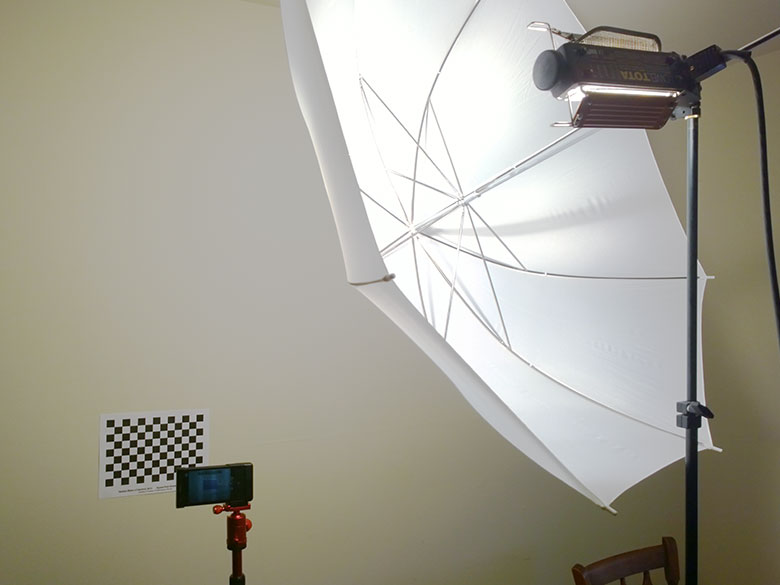
Mount the camera on a tripod that’s just about even with the same plane as your checkerboard print. You want to place it close enough so that the grid pattern fills between 25 – 50% of the frame. I made my frame a little smaller still, but the overlap seemed to be plenty. Set the camera to manual control so that everything stays consistent because you’re going to be taking at least 9 shots.  It’s most important that you set the ISO level to its lowest number.  You don’t want extra noise interfering. Don’t forget to set the file format to the camera’s RAW format.  You could do this with JPGs or TIFs too, but if you’re interested in lens correction profiles, you’re probably already shooting in RAW format and the RAW data will give you extra flexibility anyway. And if you’re going to shoot JPGs, do not use digital zoom at all ever! The DNG RAW files won’t include your digital zoom level on phones like the Lumia 1020, but if you’re shooting something as JPGs, just remember not to zoom because that will be cropping the image to a different part of where the lens is capturing data and therefore your lens correction profile won’t be correcting the correct parts of the image. It’s also important to keep the lighting constant and consistent.  Ideally you would put two lights at 45 degree angles from the checkerboard grid, but really you just need it to be bright enough for the camera and the same for each shot.
Next, you’re going to start with a shot of the checkerboard grid straight on in the middle of the frame. Then rotate the head of the tripod so that the checkerboard is placed on the top center edge, take another shot, turn it a bit more so the checkerboard is in the corner… and repeat until you have 4 shots for the corners, 4 shots for the middle of each edge, and 1 for the center.  That will give you 9 RAW DNG files.
Analyze the images with the profile creator
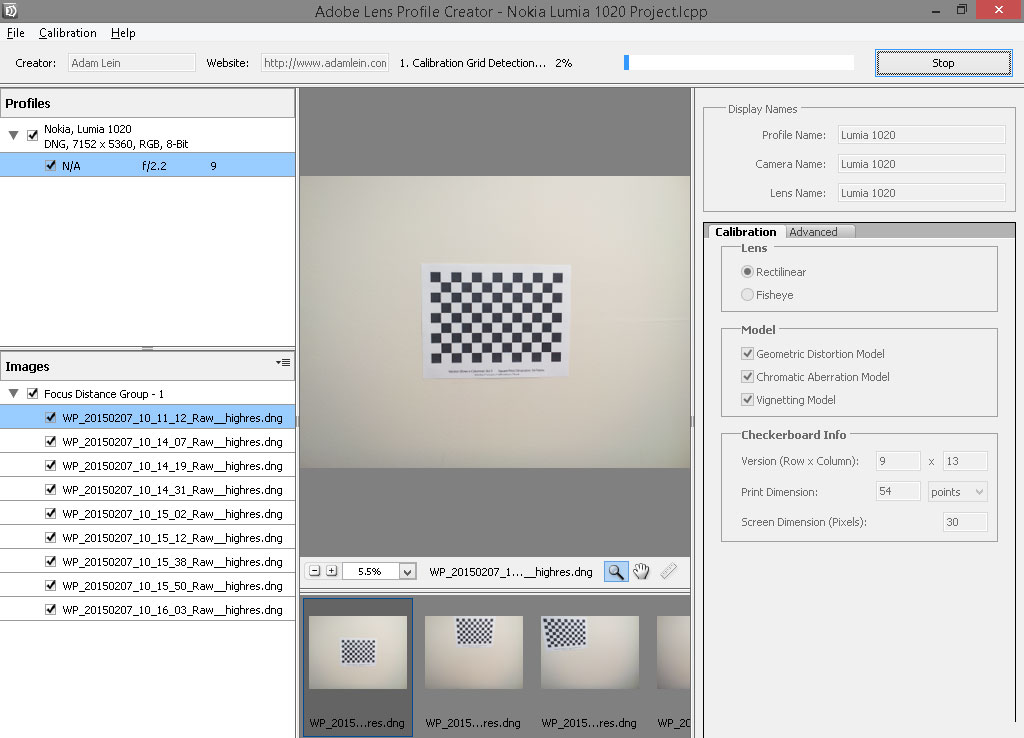
Now, just copy those DNG files from your phone to your desktop PC where you’ve got Adobe’s Profile Creator software.  Choose File > Add Images to Project and select all of the DNG files you just shot.  The software will organize them into a set on the left. In the right pane, you’ll have to type in the information about what type of checkerboard pattern you were photographing. In my case, it was the 9 x 13 version with 54 point dimensions. You can also fill out the Display name and Creator fields. Then press “Generate Profiles” and wait.  You’ll have to wait for quite a while. I believe mine took about an hour to process. When it’s finally finished, you’ll be prompted to save the newly created profile in the appropriate location.
On Windows, that would be: C:\ProgramData\Adobe\CameraRaw\LensProfiles\1.0
On Mac, the location would be: /Library/Application Support/Adobe/CameraRaw/LensProfiles/1.0
You can also save the profile to a similar folder within the user account folders, but I would rather have it accessible system-wide.
Putting it to use
Now all you have to do is open a DNG photo that was shot with your camera in the Adobe Camera Raw plug-in within Bridge or Photoshop… or open it within Lightroom.  I prefer Bridge, so below you’ll see the lens corrections tab along with the “Enable lens profile corrections” checkbox. In this screenshot, the vignetting and distortion is pretty obvious.  The corners are noticeably darker and scaled a bit differently than the center area. When I turn on the lens profile correction, the dark corners are adjusted to be far more consistent with the rest of the image, and the lens distortion is corrected as well.  Chromatic aberrations should be better, too, but I haven’t run into too many of those on the Lumia 1020’s Carl Zeiss lens.
Conclusion
This technique is naturally for the more advanced digital photographer and may be a bit daunting for average users, but since I started shooting RAW on my Lumia 1020 when it had that capability enabled, I can easily go back to my old DNG photos and apply my newly calculated lens correction profile in order to improve my old photos. You can also do this type of thing on a case-by-case basis with the manual sliders and just judge visually, but I like having a set profile that I can just apply globally. It’s probably not important if all you’re going to do is post some pictures to Instagram once in a while, but if you’re using something high-end like the Lumia 1020 for high-end photography like Steven Alvarez does for National Geographic.
Download the LCP file for the Nokia Lumia 1020.

How to make a lens correction profile for your smartphone


Britain's First Driverless Car
Britain’s first driverless car doesn’t look like a car at all. The electric-powered LUTZ Pathfinder launched Wednesday, wandering the sidewalks of London’s Greenwich neighborhood, and it’s closer in appearance to a runaway cockpit of a small airplane.
Transport Systems Catapult designed the two-seater vehicle to help people with shorter commutes. It has 19 sensors, including touch-sensitive strips, lasers, radar, and panoramic cameras. Inside, there are two screens: one informs the rider about the car’s journey, and the other is for entertainment. Behind the seats is thepower system, which has about the same strength as two high-end gaming computers.
These specs are all standard in today’s race of driverless cars, but there’s one component that’s clearly behind its competition. The LUTZ Pathfinder can only go up to about 15 miles per hour, and it runs for about eight hours before it needs recharging. But don’t laugh. For a car that’s meant to stay on sidewalks, its speed limit makes sense. Plus, the company plans on releasing a smart-phone app similar to Uber, which would allow users to hail one of these pods.
But if British Business secretary Vince Cable wants to achieve his goal of becoming a leader in this industry, the government knows it’s going to have to do better.
And the company's predecessors have set a high bar to beat. Google’s automated cars have been traversing the bridges and highways of California and Nevada since 2010. That same year, the National University of Defense Technology in China released the Hongqi HQ3, which drove 175 miles on an expressway. Apple and Tesla are also rumored to be throwing their hat in the ring together. And speaking of Uber, its CEO Travis Kalanick said the company may transition to driverless cars (though that's decades away).
Although far from a driverless hot rod, the LUTZ Pathfinder will soon have more powerful siblings. To face its competitors, the British government released an almost $29 million strategyto launch four other autonomous car projects in various locations.

Britain Launches First Driverless Car—And It’s Precious


According to The Information, Google is in the process of testing a contextually-aware mobile payment system codenamed "Plaso" around some of the company's offices in cooperation with popular businesses like Papa John's and Panera Bread. That a new Google mobile payment system is under development at all shouldn't be surprising: Wallet's abysmal adoption rate, along with competitor Softcard, have made it obvious that NFC payments aren't resonating with consumers enough to really change buying habits yet. While Apple Pay will go down this tried-and-failed road yet again, it's doing so on the hopes that wider partnerships and better marketing will finally lead to success where Wallet found only failure. Google, though, may be interested in moving beyond the NFC paradigm to something a little less hardware-dependent.
Plaso, according to this report, works thusly: you walk into a store, engage in a transaction to buy something (or potentially do so before you get there), and the cashier then asks for your initials. You reply, at which point the cashier looks at the Plaso interface (in this case, on a smartphone), finds those initials, and then [somehow] bills the purchase to you. The cashier locates your initials from a list of Plaso-enabled devices within Bluetooth range of the cashier's device, to ensure you're actually present in the store. Your device's Bluetooth connection is, essentially, a sort of mobile proximity identifier.
How Plaso payments are processed isn't explained, but TI's source claims that business owners need only a smartphone to conduct transactions , which may then feed the payment information into a backend operated by Google. It seems likely this is some kind of "middleware" approach, whereby the initial transaction goes through Google, but perhaps sees the actual vendor's payment processor complete the business end of the deal. The report isn't clear, though, so there's a lot of room for speculation.
Whether this new system is actually meant to replace NFC payments, too, isn't clear. While Google is probably unlikely to drop NFC support in Wallet any time soon, the lack of adoption may at least make Plaso a potential successor in the long term. What's weird about Plaso, though, is that it sounds a lot like Square Wallet, a service that Square discontinued about a year ago. Square's system was very similar - you ordered goods on your smartphone from the vendor, and when you got to the store you gave the cashier your name, they'd confirm it was you via your profile photo, and then give you whatever it is you ordered. Billing was completely hands-off.
If Plaso is basically this (which at this point it sounds like it is that exactly), there may yet be a potential for success where Square failed to find any.
A number of businesses in the food and drink sector are beginning to build ordering into their smartphone apps to keep customers out of the cashier line. Taco Bell, Starbucks, and Chipotle are just a few of the companies exploring the possibilities here, and it seems like a no-brainer that smaller businesses would look to a (presumably, free) middleware solution for similar functionality, even if it was a little less bespoke to their specific needs. Still, there's likely to be competition in this space, so it's impossible to say how compelling Plaso will be to business owners, or if it will even make it out of the testing stage. Regardless, we'll definitely keep an eye out for it in the future.

Google Is Testing A Mysterious New Mobile Payment System Called "Plaso" That Sounds A Lot Like Square Wallet

Wednesday, February 11, 2015

It's been almost a year since we learned of Google's experimental 3D-sensing tablet and phone technology, Project Tango. But now that Tango is in developers' hands, we're finally getting a look at what talented people can do with a radical technology.

When Google first announced Project Tango—which uses two computer vision processors, depth sensing, and a motion-tracking camera to give a tablet the same capabilities as a 3D scanner—there were plenty of ways to imagine it being useful:GamingShopping. Yes, advertising, too.
But even then, it felt a little unimaginative. Luckily, since Google distributed a couple hundred tablets to independent developers, we're getting some very creative and interesting demo apps.
Case in point: Space Sketchr, a demo app developed by Left Field Labs, a Venice, California-based studio. You can think of it as a standard drawing app—pick your colors, your pen, your patterns, and touch the tablet's screen to make a mark. Simple. One caveat: You're drawing as you move through space. Thanks to Tango's ability to track how the tablet is moving through 3D space using its embedded motion-tracking camera, it can track where and when you draw a line in relationship to the tablet—recording those movements and turning them into a 3D drawing.
Take a look at the demo video above. The user can tap on the screen as they walk through a space, drawing a spiral circle that spans out through the room. Once it's recorded, other users can explore the drawing using Tango. It's an incredible cool glimpse as how something as simple as a sketching app can become a radical user experience when 3D sensing is involved.
As Left Hand points out, it's really more of a sculpture, than anything. "Imagine a new kind of sculpture or drawing with a timeline in space," they write. "A new dimension of applications is on the verge of being discovered. You can even get it in the Google Play store here, if you're one of the lucky Tango few.

This Drawing App Is the Coolest Look Yet at What Project Tango Can Do

Tuesday, February 10, 2015

Cyanogen, the startup seeking to offer a version of Android stripped of Google services, has sought funding from a wide range of technology companies for its next round of financing.

The company has talked to a broad range of companies that includes Amazon and Microsoft, people familiar with the discussions revealed. Cyanogen is hoping to appeal to strategic investors seeking a legitimate alternative to Google’s version of the Android mobile operating system. For this same reason, some potential investors have backed off for fear of reprisal from Google.
Google develops Android and releases the core version of the software under an open source license. However, those that want to use any of Google’s services — YouTube, Gmail, Chrome or the Google Play store — have to agree to use all of them, in addition to prominent placement of those apps on the home screen. Cyanogen’s vision is a more open version of Android that could come bundled with services from other companies. Open source versions of Android have made inroads in China, while Amazon has also used the open source version to power its Kindle Fire line of tablets.
Cyanogen is currently looking to raise a Series C round that would value the company at hundreds of millions of dollars, up from a valuation of around $100 million in its prior financing round, sources said.
Microsoft is seen as a likely investor, although it has not finalized a deal, and Amazon is less likely to play a part in this round, one source said. Cyanogen declined to comment on its fundraising efforts, as did representatives of Microsoft and Amazon. The Wall Street Journal reported that Microsoft would invest in a roughly $70 million financing round for Cyanogen. Sources say that figure is in the ballpark, but could vary depending on which strategic investors end up taking part.
This is not the first time Microsoft has explored trying to use Android for its own purposes. The company inherited a product as part of its Nokia deal, theNokia X, which was based on open source Android but used Microsoft’s services in place of those from Google. It updated the product once after the deal closed, but then scrapped Nokia Xas part of a series of cutbacks last year.
Beyond who ends up signing up for the round, Cyanogen’s valuation is significant, especially for a company that has yet to show how it can make significant revenue from its efforts. As with Google’s flavor of Android, the core of Cyanogen’s offering — CyanogenMod — is free and open source. Cyanogen the company, meanwhile, could make money by bundling other services and software on top of the open source core.
In theory, it could put together a flavor of Android that bundled together services from, say, Amazon, Facebook and Microsoft, in much the same way the Google version of Android bundles YouTube, Chrome, Gmail and the Google Play store, among other services.
The company’s most significant deal is one to provide its software on phones sold by India’s Micromax. It has alsomade a number of high-profile hires in the last year as it expands both its technical and business ranks.
Cyanogen has raised more than $30 million, having raised $23 million in a Series B round that closed in December 2013; it was led by Andreessen Horowitz and included Tencent, Benchmark and Redpoint. Benchmark and Redpoint were part of Cyanogen’s $7 million Series A round that closed in April 2013.

Cyanogen Tapping Tech Giants to Build War Chest for a Non-Google Android

So let's say that you live in China and aren't sure whether you want your next phone to be an Android flavored handset, or one powered by Windows 10. Why not have both? A device called the Wen Yan Sofia has been leaked via social media in the country. Allegedly, the handset features a Dual Boot function that will allow you to choose between the two operating systems depending on how you feel at the moment.
The Wen Yan Sofia will feature a 5-inch screen with a resolution of 1080 x 1920. Intel's low-priced Sofia chip is under the hood (hence the name of the phone). That is actually an acronym that stands for Smart or Featurephone with Intel Architecture. The chip is designed to compete with Qualcomm and MediaTek silicon used in entry level handsets. The device will also include 2GB of RAM, 32GB of native storage and a 13MP rear-facing camera. A 5MP "selfie" snapper will be found on the front of the phone.
Keep in mind that the manufacturer has not yet announced the device, and Windows Phone handsets haven't been compatible with Intel chipsets, although that might change with Windows 10 for Phone. If this is legit, it sounds like the perfect smartphone for those who can't make decisions or have multiple personalities.
Wen Yan Sofia is allegedly a Dual Boot phone that runs both Android and Windows 10

 Dual Boot phone that runs both Android and Windows 10

Monday, February 9, 2015

A smartphone without a battery is like a time machine without a 1.21-gigawatt nuclear power source. In other words, it is useless – the battery is what provides that magic juice every smartphone needs to operate. 
Unfortunately, even if you take good care of your smartphone's battery, it will inevitably degrade over time and lose some of its charge capacity. At that point, it might be hard to tell if the cell is still in good health or in need of a replacement. That's why we thought we'd share a few tips on the matter.

Perform a visual inspection

You don't need to be a rocket scientist to tell a faulty battery from a healthy one. In fact, some common battery failures are easy to spot with a naked eye. If the battery of your phone is removable, simply take it obut with caution (after turning the phone off, of course) and look for symptoms like bulging, corrosion near the metal terminals, and green or white-ish stains. These are all signs that the cell is about to kick the bucket. If you don't see anything wrong with it, proceed to the next tip. If you find suspicious stains or if your cell has developed a hump, however, it is a good idea to ask your carrier or vendor for advice as your battery most likely needs to be replaced. Don't put the old cell back inside the phone as you don't want it leaking any nasty chemicals; these may damage the phone's circuitry. Instead, seal the battery in a plastic zip bag and make sure you recycle it once it is confirmed to be faulty by a professional.

Do a spin Test Of Your Battery

Your battery should not spin like this

Lithium-based batteries degrade with each discharge cycle. Not storing them properly makes matters even worse – extreme heat or cold may seriously shorten their lifespan. Another way to ruin a perfectly good battery is to drain it and leave it with no charge for a long time. Eventually, a battery might swell if not treated with care. This swelling happens slowly, usually over the course of weeks and even months, which is why a hump that has just started forming on the battery's side can be pretty hard to notice. To check if your battery cell is fine, try spinning it on a flat surface – if it spins, it might have gone bad. Obviously, this tip applies to user-removable batteries only.

Observe how fast your battery level drops

Not all phones have batteries that can be easily inspected by the user. If that's the case with your handset, you can diagnose the health of its cell by monitoring how fast its charge level drops. It is not supposed to drop by two or more percentage points at a time. (Most phones allow you to have their battery level displayed as a percentage in the status bar. If you can't find the option in its settings menu, try using a widget.) And if your battery goes from full to zero in a matter of hours even when you barely use your phone, its is probably a goner.

More battery diagnostics tips

iPhone users, here's something you might not know. Your iPhone keeps track of how many times its battery gets charged, and it also monitors the actual capacity of the cell inside it. However, this information is meant to be accessed only by Apple's support staff, hence you won't find it in your settings menu. Thankfully, there's a workaround. You just need to get iBackupBot – an all-in-one utility for managing iDevices, available on both Mac and PC (Download link). As soon as you connect your iPhone to a computer with iBackupBot running, the application will detect it and let you access detailed information about it. In iBackupBot, highlight your phone in the list of devices and choose "More Information". There you'll find your iPhone's charge cycle count, as well as the actual capacity of its battery. If the FullChargeCapacity figure is much lower than the one under DesignCapacity, then the battery may have to be replaced. (Keep in mind that a lithium-based battery usually loses about 20% of its capacity after 500 charge cycles.)
Android users, your phone also stores data about the health of its battery cell. To access it, try entering the code *#*#4636#*#* in your dialer –this should take you to a service menu where battery details are shown. If the code doesn't work, try Battery by MicroPinch (Download link). It is a simple battery monitoring tool where the health status of your battery is displayed, along with its voltage and temperature. 

Battery health tips


1. iBackupBot gives you detailed information about the health of your battery

How to tell if your smartphone's battery is healthy or bad

 
Hi-Tech Talk © 2015 - Designed by Templateism.com